
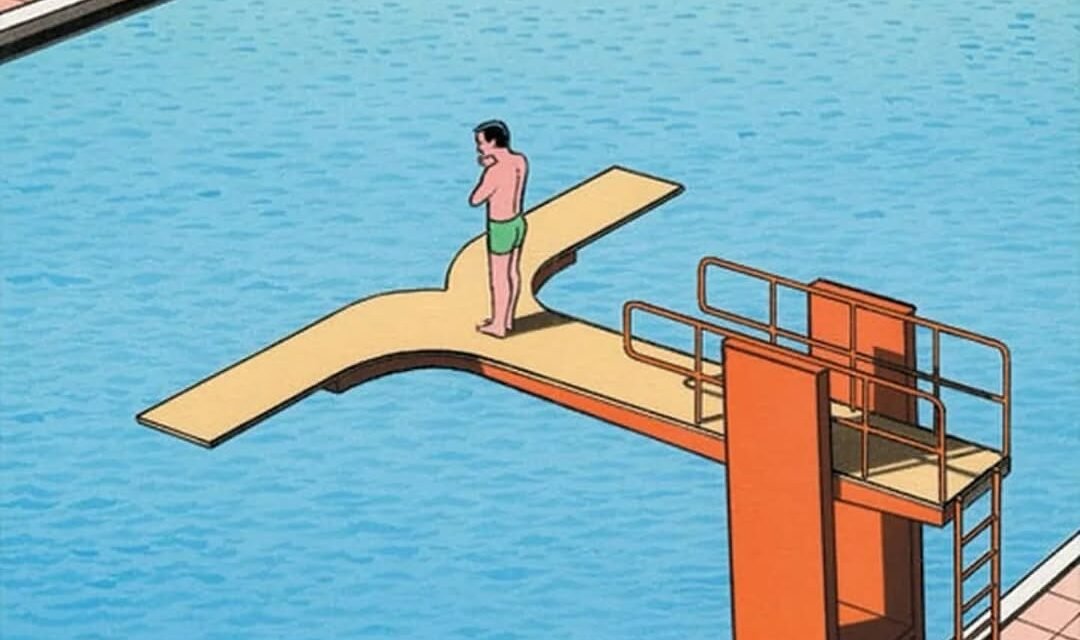
In the world of illustration, irony rarely comes from words—it emerges through form, color, and silence. Few artists have mastered that delicate balance as elegantly as Guy Billout, whose visual language reshaped how irony can inhabit the image itself.
Born in 1941 in France, Guy Billout began his career in advertising, trained to communicate with precision and clarity. But when he moved to New York in 1969, his practice shifted toward something far more introspective. His first comic strip, published in New York Magazine, portrayed an artist obsessed with America—an ironic commentary on his own experience as a newcomer observing the myths of a nation through a foreign lens.
This single work encapsulated everything that would later define his career: a controlled geometry, pristine compositions, and a quiet humor that speaks louder than satire.
Irony as Geometry: The Language of the Unexpected
Billout’s illustrations combine technical restraint with poetic surprise. His visual irony doesn’t rely on caricature or exaggeration but on subtle contradictions. A single misplaced element—a horizon too straight, a shadow that betrays reality, a structure built on absurd logic—turns an ordinary scene into a philosophical puzzle.

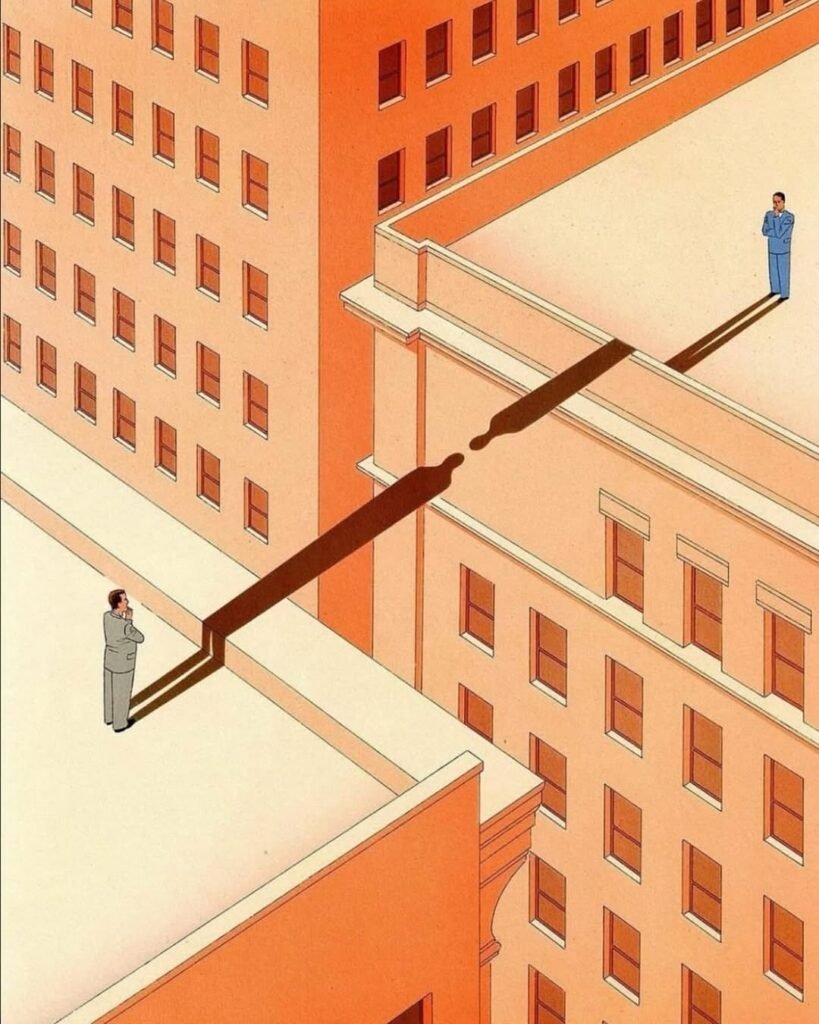
His style recalls Hergé’s ligne claire, yet beneath the simplicity lies a metaphysical unease. The viewer is invited to participate in the riddle, to sense that something is slightly off, though everything seems perfectly designed.
The subtle play between perfection and disruption in Billout’s work anticipates many of today’s digital aesthetics, where irony and sincerity coexist in the same visual language. This tension can also be traced in contemporary internet culture, as seen in reflections such as this article exploring the meme “Nature is Healing” and its cultural implications, where irony becomes a tool to decode collective anxieties about the modern world.
The Atlantic Years: The Poetry of the Ordinary
Billout’s long collaboration with The Atlantic Monthly remains one of the most refined dialogues between editorial illustration and literature. For twenty-four years, he was given a full page every two months with absolute creative freedom. His only premise: to take an ordinary moment and introduce an unexpected element.


The results are poetic paradoxes—a swimmer about to dive into a desert, a building whose reflection reveals another world, or a bridge ending in the clouds. Each image condenses humor, melancholy, and critique, reminiscent of Julio Cortázar’s short stories: the everyday turned uncanny.
Through this series, Billout redefined the illustrator’s role, transforming visual commentary into conceptual reflection. His pages became philosophical spaces, inviting the reader to pause amid the noise of journalism.
Beyond Illustration: A Philosophy of Perception
In Billout’s universe, irony is not mockery but meditation. It reveals how fragile our sense of order is—how easily meaning collapses when one element shifts. This is why his images continue to resonate in today’s visual culture, where simplicity often disguises complexity.


His work speaks to a contemporary anxiety: the desire for clarity in a world full of contradictions. And within that clarity, Billout finds poetry.
Further insights into how visual irony operates as a bridge between humor and critical perception can be found in this analysis on the visual language of irony in contemporary art, where Billout’s method is contextualized within a broader discussion about narrative ambiguity and conceptual precision.
Guy Billout’s mastery lies not in exaggerating the absurd but in framing it with elegance. His irony is architectural, built with precision and empathy, showing that even the most perfect world can hide an invisible fracture.
Read more reflections on contemporary art and visual culture at Power of Art Magazine.
