
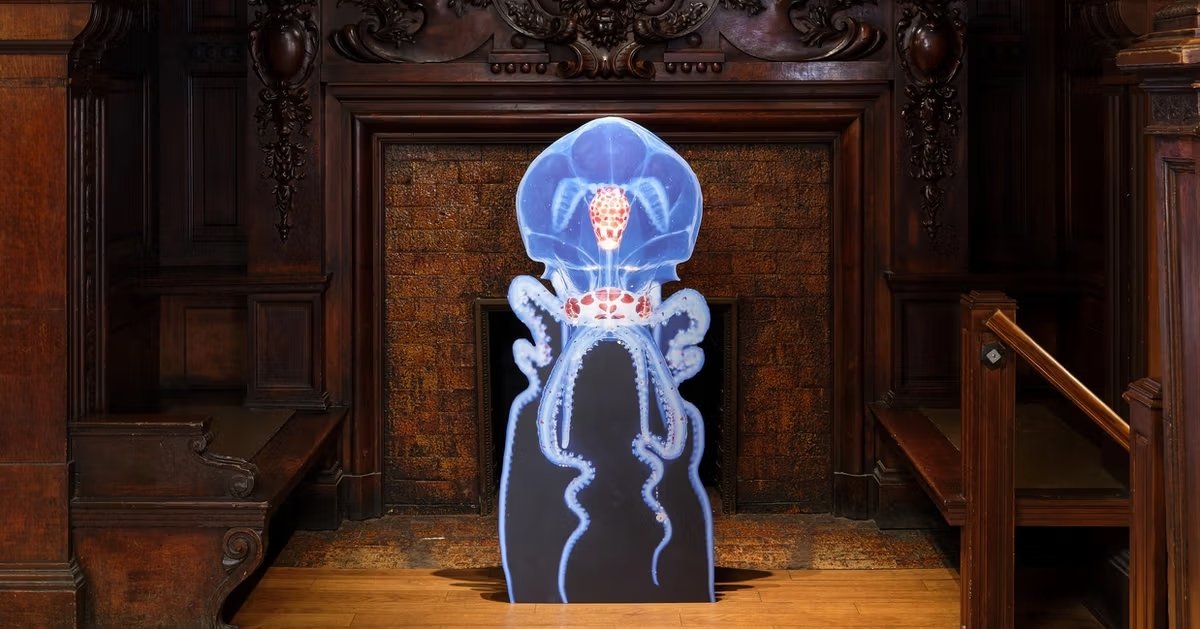
At a moment when major art fairs increasingly resemble institutional marketplaces, Esther transformed a historic Estonian cultural center in New York into something closer to a temporary curatorial ecosystem: collaborative, spatially experimental, and resistant to commercial standardization.
An independent fair built against convention
Held inside the historic Estonian House on East 34th Street during Frieze Week, Esther once again positioned itself outside the dominant logic of contemporary art fairs. Founded by Estonian gallerists Olga Temnikova and Margot Samel, the fair rejected the rigid architecture of conventional booths in favor of a fluid exhibition model integrated into the building’s Beaux-Arts interiors.
Rather than isolating galleries into transactional compartments, Esther transformed the entire structure into a collective curatorial environment. Installations spread across wood-panelled halls, basement vaults, salons, stairways, cafés and attic-like rooms, blurring distinctions between fair, exhibition and social gathering.
This third edition, announced as the final iteration in its current format, demonstrated how smaller independent fairs are increasingly attempting to redefine what participation and visibility mean within the contemporary art market.
Architecture as curatorial language
One of Esther’s most compelling dimensions was its relationship with architecture. The historical atmosphere of Estonian House became an active component of the presentations rather than a neutral backdrop.
The basement hosted an installation by Estonian artists Darja Popolitova and Madlen Hirtentreu, where beauty-industry equipment was transformed into objects resembling torture devices. Elsewhere, galleries occupied salons and intimate rooms that evoked private apartments more than commercial exhibition halls.
The result was a viewing experience built on discovery rather than spectacle. Visitors moved through layered environments instead of navigating the repetitive visual logic of art fair corridors.
This spatial strategy reflects a broader tendency within contemporary exhibition-making, where architecture itself becomes a narrative tool capable of shaping emotional and political readings of artworks. Similar intersections between visual culture, speculative environments and contemporary perception are explored in this reflection on contemporary visual systems and cultural imagination.
A fair focused on collaboration instead of competition
Unlike larger fairs dominated by hierarchy and market visibility, Esther emphasized collaboration between galleries. Several presentations were shared between exhibitors, creating hybrid displays that encouraged dialogue rather than competition.
The blue salon became a condensed expression of the fair’s identity. Temnikova & Kasela presented sculptures inspired by early artificial intelligence alongside a sculptural dress by Thea Gvetadze, while Laurel Gitlen exhibited textile compositions by Jill Goldstein and identity-focused sculptures by Max Guy. Nearby, Adams and Ollman presented paintings by Bethann Parker that visually hovered between landscape and textile abstraction.
This coexistence of practices reinforced Esther’s refusal of rigid categorization. Painting, sculpture, installation, textiles and speculative design existed together within domestic-scale spaces, creating a slower and more conversational viewing rhythm.
The political reality behind independent art systems
Although Esther avoided overt political branding, geopolitical anxieties remained present beneath the surface. Péter Bencze, co-founder of the Budapest-based gallery Longtermhandstand, reflected on building an international program without state support during Hungary’s increasingly authoritarian political climate.
His comments revealed a larger reality affecting independent art ecosystems globally: many smaller galleries now operate through networks of collaboration and resilience rather than institutional infrastructure.
At the same time, concerns about the American art market becoming more inward-looking, and the growing instability surrounding Eastern Europe, hovered over conversations throughout the fair. These tensions gave Esther an atmosphere distinct from the celebratory tone often associated with art-market events.
Ending at its peak
Despite its modest scale, Esther generated strong commercial results. Several galleries sold out their presentations during the opening preview, while others reported acquisitions by influential collectors.
Yet the fair’s significance extended beyond sales. Esther offered an alternative proposition: that an art fair could function not merely as a marketplace, but as a temporary cultural micro-community shaped by architecture, experimentation and shared vulnerability.
Its conclusion in this format feels symbolic of a broader transition occurring within contemporary art. As mega-fairs become increasingly institutionalized, projects like Esther reveal a growing desire for spaces that privilege intimacy, curatorial identity and critical atmosphere over spectacle alone.
Esther’s final edition demonstrated that scale is not what defines cultural impact. In an art world increasingly shaped by repetition and market predictability, the fair proposed another possibility: slower encounters, unstable architectures and communities built through collaboration rather than dominance.
Read more reflections on contemporary art and cultural systems at Power of Art Magazine.
